Sunday, May 27, 2012

Sri Pathra Kaliamman Temple (Pulau Pangkor), Perak


The beautiful coastline of Pulau Pangkor has a hidden treasure, vaulted deep in its sandy beaches. Kaliamman, the ferocious form of Shakti, is indeed an unpolished diamond, and moreover is deeply protective of her adoring devotees.  Like a mother who constantly looks over her flock of children, she looks after the welfare of Pangkor residents, and guides, protects and nurtures them. Nestled on the beaches of Pangkor, the temple is a beacon of spirituality. The past of  Kaliamman temple indicates that fisherman from India built a shrine for this goddess 150 years ago, to protect them from the turbulent, unpredictable, deadly waves of the sea. They had installed a ‘trisulam’ (trident), and lit up camphor, lime lamps, and offering of flower, before proceeding to the sea. After a good catch, there was usually an animal sacrifice, which is not practiced anymore. Later on, the shrine was renovated and devotees installed a granite statue of Kaliamman, beneath a neem tree. In the earlier days of the temple, it was in close proximity to the beach, so much so that during Amavasai (new moon) and Pournami (full moon) the sea used to ascend the silky sands of the beach, just reaching the blessed feet of Kaliamman. 

There are many tales of endearment of this temple, which describes her predominant presence. A blind man, who used to live near the temple, had always lamented his deplorable condition. One day, the blind man heard a mysterious, raspy voice, instructing him to light oil lamps at the Kaliamman temple, and that his blindness would be cured. He earnestly followed this spiritual edict, and over time his blindness was completely cured. As a mark of devotion, he used to carry ‘kavadi’ (spiritual dance) for Kaliamman during the yearly Masi Magam festival until he passed away. Another tale was that the granite statue of Kaliamman was stolen by bandits, and thrown into the sea. A deeply anguished devotee, dreamt of her telling that she was in the sea, and gave a precise description of where to find the statue. Soon she was found, and all her devotees rejoiced with a celebration. Many devotees have had scintillating visions of the goddess. Some have seen her sitting on a rock, combing her deep, black hair, under the shiny moon glow of Pournami and Amavasai. Others have seen gentler form of Kaliamman, in the form of a small girl with silver anklets, running around the temple, and its inner sanctum. 

The most distinct aspect of this temple is that it faces the sea as well as the direction of east. Therefore it has a twofold feature, whereby devotees are blessed with the energy of the sun, as well giving the opportunity for devotees to bathe in the sea to remove negative energy. In addition, the temple has a 60 kilogram ‘trisulam’ facing Kaliamman, forged from ‘aimpon’ (5 metals). It is 6 feet in length, and has engravings of the sun, moon, 27 ‘nakshtra’ (stars), 12 ‘rasi’ (moon sign), and other holy symbols. The highlight of this temple is during Masi Magam, whereby the temple’s annual ‘tiruvila’ (festival) is celebrated with much joy, pompousness, and spiritual glee. During this annual festival, the deity is taken around the temple and is taken to the sea to be bathed in 'kadal tirtham' (seawater), before proceeding back into the temple.

Address: Sungai Pinang Besar, Pangkor. Contact: 016-6939575 Sharma Iyer

Monday, November 14, 2011

Sri Thendayuthapany Alayam, Cameron Highlands (Perak)

This massive spiritual edifice was planned, constructed and managed by the early Hindu settlers of Cameron Highlands, mostly from Department of Road Works. It is believed to have been initiated by Govinda Chettiar, a pious devotee, who wanted the Hindu community of Cameron Highlands to receive the divine blessings of Lord Thendayuthapany. The initial structure of the temple was built in 1930, and was later renovated several times to accommodate the growing number of the Hindu community in Cameron Highlands. To date, it is the biggest Hindu temple in Cameron Highlands, and serves the Hindu community to its utmost capacity.

The temple’s yearly ‘Tiruvila’ (Temple Celebration) is held on Chitra Pournami, and is conducted in a grand scale. Hundreds of staunch devotees descend from all over Malaysia, and Singapore, to participate in the ‘Tiruvila’, and show their gratitude to Lord Thendayuthapany. The temple has a strong following of the Chinese society, mostly from the business community. These businessmen seek the blessing of Lord Thendayuthapany before a business endeavour, and if successful, contribute back to the temples as an act of gratitude. Lord Thendayuthapany in Cameron Highlands is also famed for blessing offspring to childless couples. Many couples seek Lord Thendayuthapany’s spiritual intervention to obtain an offspring, and their pleas are mostly answered. Some ardent Hindu devotees have had the vision of Lord Thendayuthapany in this auspicious temple, as a youthful deity, holding the eternally powerful ‘Vel’ (Divine Spear). The statue of Lord Idumban has also been consecrated at this temple, and his ‘shakti’ (divine energy) is supposed to be very strong. Many devotees seek his blessing to cure ailments, black magic curses, financial difficulties and domestic problems.

The ‘shakti’ (divine energy) of this temple is alluringly powerful due to the gold ‘yantra’ (sacred diagram) consecrated at the bottom of main sanctum. As gold contains the highest spiritual element amongst all metals, hence it is able to transmit divine blessings from the heavens upon the visiting devotees to this temple. Another important aspect is the ‘Vel’ and ‘Kodi’ (flag) of this hilly temple. Both are the primary symbols of Lord Thendayuthapany, and are made from silver, which is the second most auspicious metal after gold.

Sunday, August 7, 2011

Arulmigu Arumugaswamy Dhevasthanam, Kangar (Perlis)

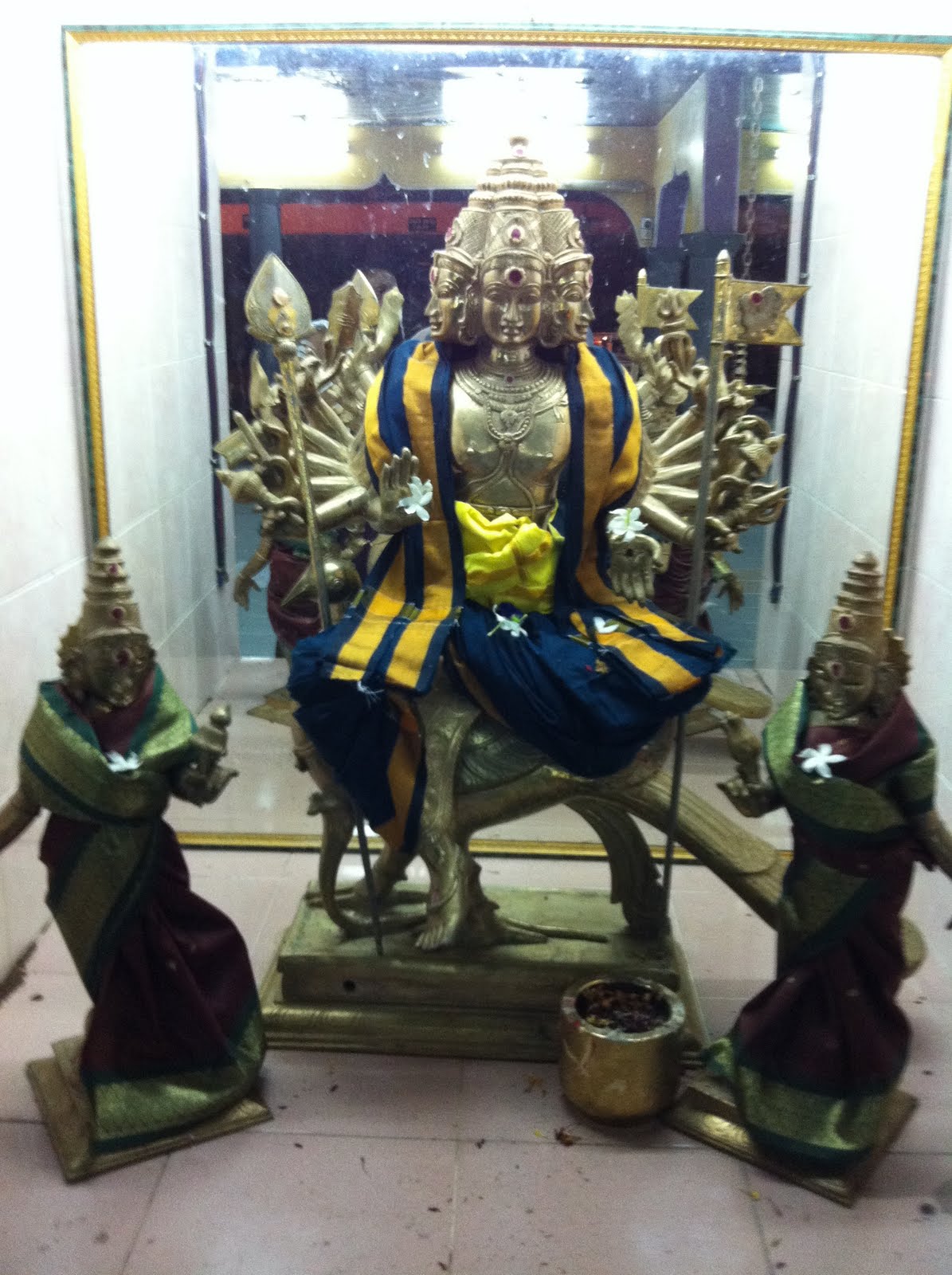
Originally built in 1968, this majestic temple is distinctive as it is one of the rare temples in Malaysia whereby Lord Muruga is in his fierce battle form, ever ready to annihilate evil ‘asuric’ (demonic) forces. The mighty Lord Arumugaswamy presides here as a six faced deity with his two consorts, Sri Valli and Sri Devayanai in the main ‘moolasthanam’ (inner sanctum). Lord Arumugaswamy’s statue is made from ‘Karungkal’ (black granite), whereby his front three faces are face forward and the other three faces the back. Each of Lord Arumugaswamy’s twelve hands holds a weapon to suppress the ‘asuras’.

A significant historical moment of this temple was in December 1981 when the late Swami Kirubanantha Varriyar visited the temple. In July 1992, the temple was again blessed by the visit of the late Swami Kirubanantha Varriyar. He counselled the temple management to take great care of this temple, as there were only few temples in the world that had Lord Arumugaswamy, in his six faced form in the ‘moolasthanam’ (inner sanctum). In January 2005, the temple was visited by an Australian Hindu, Carl Vadivel Belle. He was on his holy pilgrimage to Malaysia for Thaipusam and made a visit to the temple. He felt the mystical spiritual presence of Lord Arumugaswamy when he entered the temple.

Another important aspect of this temple is the Golden ‘Vel’, which was donated by a spiritual aspirant in Perlis. The Golden ‘Vel’ has been since used in many major temple festivals, particularly for ‘Vaigasi Vishagam’. The festival ‘Vaigasi Vishagam’ is observed in the month of May-June, on a full moon day. The day is supposed to be whereby Lord Arumugaswamy incarnated in this world to battle evil ‘asuras’.

Address: Jalan Jubli Perak, Bukilt Lagi, 01000 Kangar, Perlis. Tel: 04-9764441

Sunday, January 30, 2011

Sri Mahalaxmi Alayam, Ipoh (Perak)

As there is very few temples dedicated to Goddess Laxmi in Malaysia, this shrine stands out like a blooming pink petal lotus on murky mud. In the 1960’s, a Hindu devotee by the name of Mr.Samy brought a Laxmi statue to Malaysia from the sacred Tiruvanamallai hills from Tamil Nadu, India. He chose to build a shrine for Goddess Laxmi in the outskirts of Ipoh town, as there are plenty Hindu residents in this area. In addition, the selected area was in a jasmine orchard, therefore more apt for the worship of Goddess Laxmi. In 1990, the shrine was renovated, and was completed during “Varusha Pirappu” (Tamil New Year), hence a yearly festival was held during the “Varusha Pirappu”. During this period, the previous cement statue was replaced by a granite statue, to allow the pouring of ritual “Abhisekham” (liquid oblations).

This shrine is renowned for the blessings of offspring to childless couples. Many Hindu couples from around Malaysia come to this temple to seek Goddess Laxmi’s blessings to have children, and are never disappointed. In addition, Goddess Laxmi always takes care of her ardent devotees, ensuring their welfare is her priority. There was an old lady who used to take of this shrine. She used to clean the shrine daily, and light the “Kuthu Vilakku” (Oil Lamp). Her spiritual chores were taken over by a full time priest, as she was getting old. Due to ill-fate, the old devotee became paralysed. Despite her disability, she visited the shrine daily, praying to Goddess Laxmi. Her spiritual endeavour was blessed by Goddess Laxmi, as the devotee soon recovered from her ailment. Another dedicated devotee used to offer lotus flowers every Friday to Goddess Laxmi at this shrine. On the way to work by motorcycle, the devotee was knocked by oncoming vehicle. Despite the motorcycle becoming a total wreck, the devotee was completely unscathed. A crowd of onlookers claimed to have witnessed a bright light hovering around the devotee during the accident. Some devotees have also had visions of Goddess Laxmi, giving spiritual advice when necessary. The vision of Goddess Laxmi, was described that she was seated on a pink lotus, had brilliant golden complexion and was wearing a luminous green sari with pink borders.

There is also an idol of Nagamman at this shrine, who is the guardian deity of this shrine. Her existence is confirmed by the presence of a very large cobra, which frequents the shrine after dusk. Devotees who come late to the shrine have witnessed the cobra slithering out of the shrine. In addition, there is a “Trisulam” in this shrine, which is supposed to have been located in this shrine since the establishment of the shrine.

Address: 142, Jalan Lahat, Ipoh, Perak. Phone: 019-5128110 (Mr.Tamil Selvan)

Sunday, November 28, 2010

Athi Eeswaran Temple, Sentul (Kuala Lumpur)

This majestic temple, with the largest ‘Raja Gopuram’ (royal tower) in South East Asia, was built in 1937 by a group of dedicated Saivite followers, lead by the late Dr.Viswalingam. The calm and refreshing vibration in this temple is spiritually intoxicating, nourishing for the soul, plucking off every worry in the stifling mind. This temple is strategically located opposite a Hindu burial ground, whereby the ashes of the crematorium are blown towards the entrance of the temple. Temples of this type are rare, and are known as ‘moksha’ (spiritual salvation) temples.

The ‘Shiva lingam’ (denoting the infinite energy of the Lord Shiva) which has been consecrated in this temple, originates from the holy river Ganges in Kashi, India. The original founder of this temple, Dr.Viswalingam had made a pilgrimage to India. As he was bathing in the holy Ganges river, he found this sacred ‘Shiva lingam’. This particular type of ‘Shiva lingam’ comes only from Narmada River, located in the west of India. This ‘Shiva lingam’ from Narmada river has been made popular by the movie ‘Indian Jones and the Temple of Doom’, whereby Indiana Jones was searching for the sacred ‘Shiva lingam’.

The faithful devotees who ardently attend to ‘Puja’ (Act of reverence through invocations, songs, prayers and rituals) at this temple are abundantly blessed. A dedicated lawyer, who has been actively serving this temple, was promoted to a judge. Another prominent businessman, who was having a downturn in his business, soon regained the profitability of his business after repeatedly donating for ‘Abhishekam’ (Pouring libations on the consecrated deities). In addition, there was an ill-stricken cancer patient, who continuously recited the ‘Mahamrityunjaya Mantra’ (A life restoring mantra dedicated to Lord Shiva), was miraculously cured in 3 months.

Address: Jalan Pusing, Sentul , 51000 Kuala Lumpur.

Tel: 03-4041 1028

Tuesday, September 21, 2010

Muthu Mariamman Temple, Muar (Johor)

‘Muthu’ is defined as pearl in English is the adjective given to this divine form of Goddess Amman. Many devotees pray to this village deity to remove chicken pox or small pox. Hence the adjective ‘Muthu’ is given whereby the gentle goddess takes the disease upon herself, relieving her devotees. A shrine dedicated to Goddess Muthumariaman was believed to have been built in Muar town more than 100 years ago. It was renovated in the 1930’s by prominent Hindu businessman of the town and established as a temple. Initially there was a ‘trisulam’ (three pronged trident) in the main sanctorum, but was replaced by a granite statue.

One of the founders of the temple, Mr.Subbayah was an ardent devotee of the Goddess, and had taken her to be his ‘Kula Deivam’ (ancestral deity). After his daily trip to the temple, only then would he begin his chores. Due to his fondness towards Goddess Mariamman, Mr.Subbayah was blessed with a vision of the deity. In this divine revelation, he was told by the Goddess that during the yearly ‘Kovil Thiruvila’ (temple festival), she was always paraded around the temple in a chariot. The trip had always made her tired, and she gracefully requested to build an ‘Oonjal’ (swing). This was to allow devotees to swing her on the ‘Oonjal’, and chant soothing lullabies that will let her sleep. After this vision, Mr.Subbayah immediately built the ‘Oonjal’, and initiated the ‘Oonjal’ ceremony. Goddess Muthumariamman is ever endearing to her loyal devotees, especially in crisis. Once, a lady devotee was quarrelling with her husband. After the verbal disparage, the lady devotee decided to spend the night at the temple. Unable to sleep at night, she had a dream of Goddess Mariamman patting her back, encouraging her to sleep, and reassuring that everything would be better the next day.

The former President of Singapore, Mr.Sellapan Ramanathan who was born in Singapore but had spent his childhood in Muar, had vivid memories of this magnificent temple, which he often visited. Mr.Ramanathan and his wife Mrs.Urmila visited the Muar Muthumariamman temple on Sunday 10 June 2007, paying homage to their beloved deity. The unique aspect of this temple is the 13 day ‘Kovil Thiruvila’. It is held once a year, and is always overlapping the ‘Navarathri’ (Nine nights) festival. The festival is held in honour of Goddess Muthumariamman, and each day she is worshipped with intricate rituals, until the culmination of the festival.

Address: 29, Jln Mohammadiah, 84000 Muar. Tel: 06-9515470